

By Nathan Lerner
Film Critic
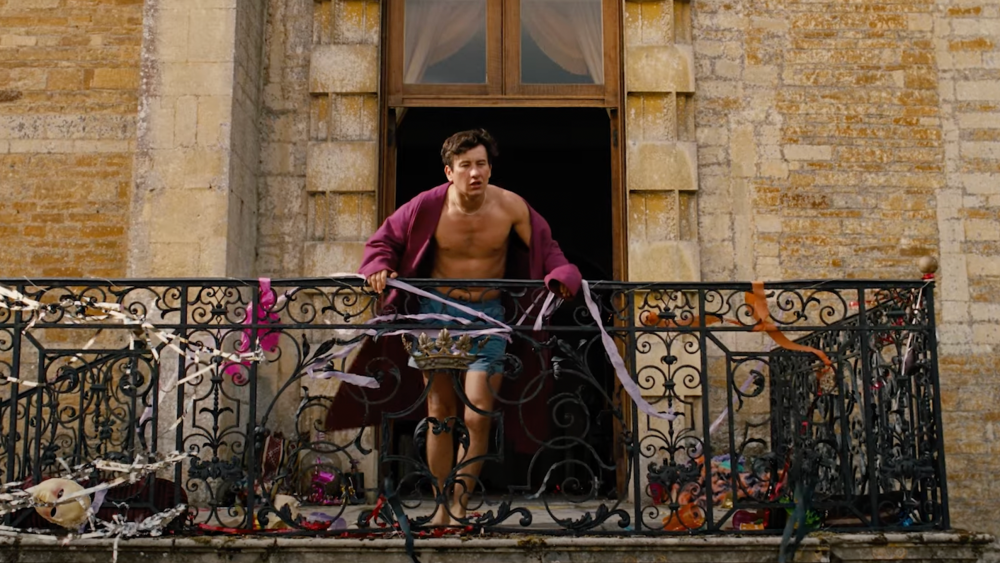
For three consecutive years, the Philadelphia Film Festival has allocated some of its most coveted slots to vehicles that showcased Irish talent. In 2021, the festival’s opening night film was Belfast, the loosely autobiographical work, penned and directed by Kenneth Branagh. It recounted his childhood in Northern Ireland’s capital city. In 2022, the festival kicked off with The Banshees of Inisherin. The tale was set on a fictitious island in Galway Bay, off the western coast of Ireland. It starred the estimable duo of Colin Farrell and Brendan Gleeson as life-long friends, whose relationship becomes abruptly truncated. This year, in its 32nd edition, the festival’s closing night film was Saltburn. Dublin native, Barry Keoghan, is cast as the film’s protagonist.
Set in 2006, Saltburn is at once a jocular, albeit scathing, satire of the British ruling class and a psychological thriller. It centers on Oliver Quick (Keoghan), an incoming freshman at prestigious Oxford University. Unlike his posh classmates, Oliver hails from a modest background and is a socially maladroit dweeb. His parents are apparently addled with alcoholism and drug addiction. He has no siblings or other familial supports to speak of. Oliver is an obvious candidate for ostracism by his more privileged peers.
In the film’s prologue, Oliver speaks retroactively of the ambivalent, tortured, and unrequited feelings that he had harbored for Felix Catton (Jacob Elordi). Felix is a strikingly handsome alpha male, whose family boasts a centuries-old aristocratic pedigree. Felix is accustomed to people fawning over him. In particular, wherever he goes, he is avidly pursued by a bevy of pulchritudinous coeds. Meanwhile, Felix remains totally oblivious to Oliver’s homoerotic longings for him.
The two lads meet serendipitously, when Jacob experiences a flat tire on his bicycle. He is distressed by the prospect of being tardy for a meeting with his new faculty advisor. As Oliver rides past, he notices Felix’s predicament. Oliver veers from the pathway and graciously offers to lend his own bicycle to help the immobilized stranger. Felix expresses his deep-seated gratitude.
Felix defies audience expectations, when he actually takes pains to incorporate Oliver into his elite social clique. As summer break beckons, Felix magnanimously invites Oliver to sojourn at his family home, the eponymous Saltburn. It turns out that the family residence is a sprawling Medieval castle from a bygone era. Drayton House, an edifice situated in Northamptonshire, afforded an ideal site for location shooting. Construction of the spectacularly opulent estate began around 1300 and was repeatedly revised thereafter. Shortly after the house was erected, the original owner of the magnificent structure was issued a license to build ramparts and crenellations as part of a protective wall around the residence.
When Felix gives a tour of the estate to Oliver, he parenthetically references family lore. As a vestige of a tryst that the notoriously licentious Henry VII once had while visiting the estate, the monarch’s desiccated seminiferous fluids are reputed to remain embedded in the mattress in one of the guest rooms. Imagine living in a home with such a juicy historical tidbit attached to it.
Oliver soon meets the residents of Saltburn, a menagerie of well-drawn and altogether eccentric characters. Felix’s immediate family consists of his mother, Elsbeth (Rosamund Pike); his father, Sir James (Richard E. Grant); and his sister, Venetia (Alison Oliver). They are augmented by Felix’s snide biracial cousin, Farleigh Start (Archie Madekwe), who also matriculates at Oxford, and a non-family hanger-on, literally known as “Poor Dear” Pamela (Carey Mulligan). All of the thespians convincingly embody the solipsistic sense of entitlement that is routinely exhibited by upper-class British twits.
However, ultimately it is Keoghan, who delivers a particularly delicious performance that anchors the film. He adroitly captures the evolution of his screen character over the course of the film’s protracted narrative trajectory. Last year, Keoghan as well as his cast-mate, Brendan Gleeson, each scored a supporting Oscar nomination for their respective roles in the aforementioned The Banshees of Inisherin. Keoghan portrayed a cognitively impaired villager in the film. Here, Keoghan demonstrates his versatility, while enlivening a far different role. He establishes that he is capable of carrying a feature film as its lead.
Saltburn is the sophomore venture of Emerald Fennell. In 2020, she made a successful transition from actor/showrunner to screenwriter/director/co-producer with her debut feature, Promising Young Woman. The film generated an Oscar for Fennell’s Best Original Screenplay along with nominations culled for Best Picture, Best Director, Best Actress (Carey Mulligan, who as noted plays a juicy supporting role in Saltburn), and Best Editing. Here, Fennell shows impressive growth as a filmmaker. Her screenplay is chocked full of plot twists and apt metaphorical constructs. Fennell makes efficacious use of dramatic foreshadowing and misdirection. Following a faux denouement, Fennell uses a double epilogue to mount a startling montage of events, juxtaposed with a memorable true finale. In her role as director, Fennell evokes strong performances from her entire ensemble cast and handles the film’s frequent tonal shifts with dexterity.
The production values of Saltburn are superb. Cinematographer, Linus Sandgren (La La Land), makes adroit use of light, mirrors, and reflections to fashion a litany of mindboggling images. His use of a 1:33:1 aspect ratio creates the sensation that the viewer is a voyeur, who is surreptitiously spying on the most intimate machinations of the film’s onscreen characters. The editing by Victoria Boydell keeps the pacing taut and the audience guessing what will transpire next. The evocative score by Anthony Willis (M3gan) provides an excellent complement to the visual text of the film. The choice of period pop hits buttresses the film’s sense of time and place.
For all my enthusiasm for Saltburn, I would be remiss if I did not provide a caveat to prospective viewers. The film includes explicit dialogue as well as repeated depictions of drug use and decidedly twisted psychosexual expression. One vignette involves a libertine, who is ruefully disparaged as “sexually incontinent,” and her liaison with an accommodating paramour. Another scene depicts more “mundane” intercourse. These carnal interludes are not gratuitously ribald. Instead, they capture the sublimated urges of various screen characters as well as the intolerant deprecations of their more priggish detractors.
After appearing at the Philadelphia Film Festival, both Belfast and The Banshees of Inisherineach went on to accrue a plethora of Academy Award nominations as well as other accolades. Although Saltburn is a far more polarizing film, it is richly deserving of similar recognition.
**** MPA rating: R (for strong sexual content, graphic nudity, language throughout, some disturbing violent content, and drug use)127 minutes
Nathan Lerner was a syndicated Film Critic for the Montgomery Newspapers Chain and its corporate successors for twenty years. He welcomes feedback at [email protected].